Strengthening Science Education in Rural Communities
Midwestern University welcomes STEM educators to explore innovative teaching strategies
Midwestern University Glendale Campus hosted the third annual National Rural STEM Learning Summit on September 3 and 4. The summit, organized by the Arizona Science Center and the SciTech Institute, brought over 200 educators together to enhance science education in rural communities across the country.
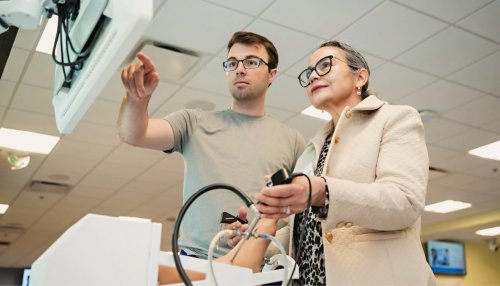
In addition to hosting the summit, Midwestern conducted workshops for educators to discover the technology used in campus classrooms and labs, and a reception for them to talk with students from each program. Three University faculty members, Jacqueline Spiegel, M.S., PA-C, Director of Clinical Skills Simulation Center, Ryan Palmer, Director, Education Innovation and Development, and Shannon Scott, D.O., Medical Director, Arizona College of Osteopathic Medicine, were on the Summit’s Healthcare 2030 panel. In addition, two other faculty members, Heather Smith, Ph.D., Professor, Anatomy, and Carleton ‘Buck’ Jones, Ph.D., Associate Professor, Biomedical Sciences, presented at the Summit breakout sessions.
Making Meaningful Scientific Connections
At Dr. Smith’s presentation on innovative anatomy, she introduced the study of animal skulls as a tool for teaching anatomy, evolution, and ecology.
“Science, especially the biological sciences, often becomes more meaningful for students when they can directly interact with specimen representing the natural world,” Dr. Smith said. “Hands-on experiences, such as working with animal bones, can help them make connections about the world around them. In the case of this workshop, examining skulls and evaluating their anatomical details can help students understand the connection between anatomical form and function across the animal kingdom.”
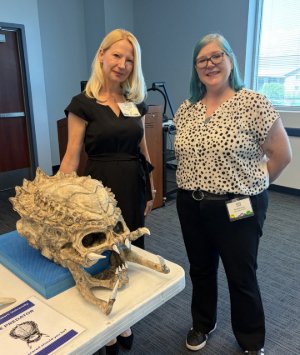
Through the interactive workshop, participants learned how skull structure can reveal information about diet, behavior, and evolutionary relationships among species. Dr. Smith showed a collection of real specimen and 3D printed skulls, color coded to easily identify anatomical similarities across species.
“My primary advice for educators is to create opportunities for hands-on exploration, observation, and discovery of the natural world, because those experiences often facilitate the deepest learning,” she recommended.
Dr. Smith shared her hopes of inspiring curiosity for science: “As an anatomist and paleontologist, I’m constantly fascinated by what bones and fossils can reveal about life on earth. I’m motivated to further STEM education because I want students to experience the same feeling of discovery and awe, and to see that doing science is like solving a real-life mystery. The idea that an activity may spark a student’s interest in science and inspire them to pursue it, either formally or informally, is a powerful motivation.”
Inspiring Lifelong Learning
Dr. Jones presented on the barriers rural students may face in pursuit of a scientific education, and the subsequence shortage of healthcare providers in rural areas. “Despite 20% of the U.S. population being rural, only 10% of doctors practice in rural areas,” Dr. Jones shared. “Furthermore, only 5% of medical school applicants are from rural areas.”
He explained that the largest barriers for rural students entering healthcare professions are not cognitive, but behavioral. “Rural students often think science must be too complicated and difficult, but research consistently shows that they perform equally well upon entering science degree programs,” Dr. Jones said. “If we can get more rural students to consider educational pathways like medical school, research shows they are twice as likely to return to rural areas to practice healthcare.”
To help students become lifelong learners, he emphasized that educators should prioritize teaching scientific literacy. “Over the last decade, the greatest declines aren’t in factual knowledge, but in students’ ability to think scientifically, evaluate evidence, and apply critical reasoning. Teaching the scientific process helps students become lifelong learners who can navigate an increasingly complex world,” Dr. Jones said.
The Responsibility to Educate
Sponsoring the National Rural STEM Learning Summit gave Midwestern the opportunity to extend the impact of scientific education beyond campus classrooms. Dr. Smith concluded, “As a university, we have a responsibility not only to educate our own healthcare students, but also to share knowledge with the broader community. Workshops like this help educators bring engaging, educational STEM experiences to their students, and hopefully inspire the next generation of scientific thinkers.”